A 55-year-old woman is hospitalized for shortness of breath, productive cough, and pleuritic chest pain. Her medical problems include major depression and schizophrenia, and her medications are unknown. In the emergency department, her trachea is intubated due to respiratory distress, a right internal jugular catheter is placed, and normal saline is administered as repeat boluses.
In the intensive care unit, her temperature is 38.9 C (102 F) , blood pressure is 85/42 mm Hg, and pulse is 115/min. The patient's pulse oximetry shows 90% on assist-control mode with a respiratory rate of 16/min, tidal volumes of 470 mL, fraction of inspired oxygen of 70%, and positive end-expiratory pressure of 10 cm H20. Examination shows bibasilar crackles and normal first and second heart sounds. The abdomen is soft and nontender. There is no peripheral edema. The extremities are warm to the touch with faint pulses. Mean central venous pressure is 14 mm Hg.
Laboratory results are as follows: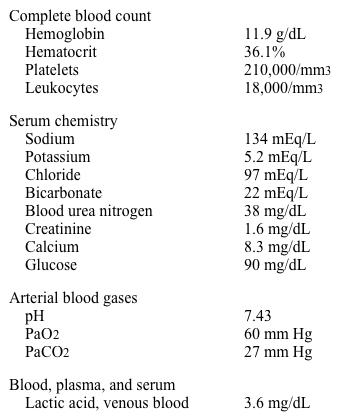
Chest x-ray shows bilateral diffuse alveolar opacities.
Which of the following interventions is the best next step in management of this patient?
A) Dobutamine infusion
B) Hydrocortisone injection
C) Norepinephrine infusion
D) Red blood cell transfusion
E) Repeat normal saline boluses
Correct Answer:

Verified
Q89: A 74-year-old man is brought back to
Q90: A 57-year-old man undergoes bronchoscopy for a
Q91: A 68-year-old woman is evaluated in the
Q92: A 70-year-old woman is brought to the
Q93: A 79-year-old man on mechanical ventilation is
Q95: A 43-year-old man with alcoholic pancreatitis is
Q96: A 36-year-old woman comes to the emergency
Q97: A 65-year-old woman with a history of
Q98: A 63-year-old man with chronic obstructive pulmonary
Q99: A 65-year-old woman with a history of
Unlock this Answer For Free Now!
View this answer and more for free by performing one of the following actions

Scan the QR code to install the App and get 2 free unlocks

Unlock quizzes for free by uploading documents