A 43-year-old man with alcoholic pancreatitis is brought to the intensive care unit with acute respiratory failure. His chest x-ray shows bilateral alveolar opacities. His trachea is cannulated and low-tidal volume mechanical ventilation is initiated. Imipenem/cilastatin is continued for necrotizing pancreatitis. Three days later, his oxygen requirement has decreased and his chest x-ray shows improvement.
His temperature is 37.8 C (100 F) , blood pressure is 134/72 mm Hg, and pulse is 86/min. The patient's pulse oximetry shows 100% on assist control mode with tidal volumes of 470 mL, respirations of 18/min, fraction of inspired oxygen of 50%, and positive-end expiratory pressure of 5 cm H20. He is not on vasopressor agents. His urine output over the last 6 hours is 50 mL/hr.
Laboratory results are as follows: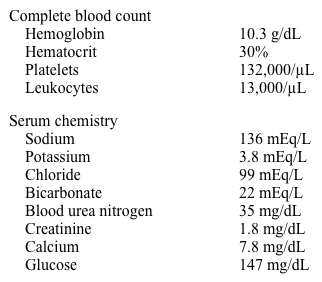
After successful completion of a spontaneous breathing trial, the patient is extubated and placed on nasal cannula oxygen. Five hours later, he complains of shortness of breath. He appears to be in respiratory distress and uses accessory muscles of respiration. His blood pressure is 157/99 mm Hg and his pulse is 122/min. His respiratory rate is 36/min and was 28/min 2 hours earlier. His oxygen saturation is 86% on 50% face mask oxygen. Chest examination shows decreased breath sounds at the right base and bilateral coarse rhonchi.
Which of the following is the most appropriate next step in management?
A) Adequate deep airway suctioning
B) Endotracheal intubation and mechanical ventilation
C) Intravenous loop diuretics and 100% face mask oxygen
D) Intravenous morphine and nitrates
E) Noninvasive positive-pressure ventilation
Correct Answer:

Verified
Q90: A 57-year-old man undergoes bronchoscopy for a
Q91: A 68-year-old woman is evaluated in the
Q92: A 70-year-old woman is brought to the
Q93: A 79-year-old man on mechanical ventilation is
Q94: A 55-year-old woman is hospitalized for shortness
Q96: A 36-year-old woman comes to the emergency
Q97: A 65-year-old woman with a history of
Q98: A 63-year-old man with chronic obstructive pulmonary
Q99: A 65-year-old woman with a history of
Q100: A 60-year-old woman is brought to the
Unlock this Answer For Free Now!
View this answer and more for free by performing one of the following actions

Scan the QR code to install the App and get 2 free unlocks

Unlock quizzes for free by uploading documents